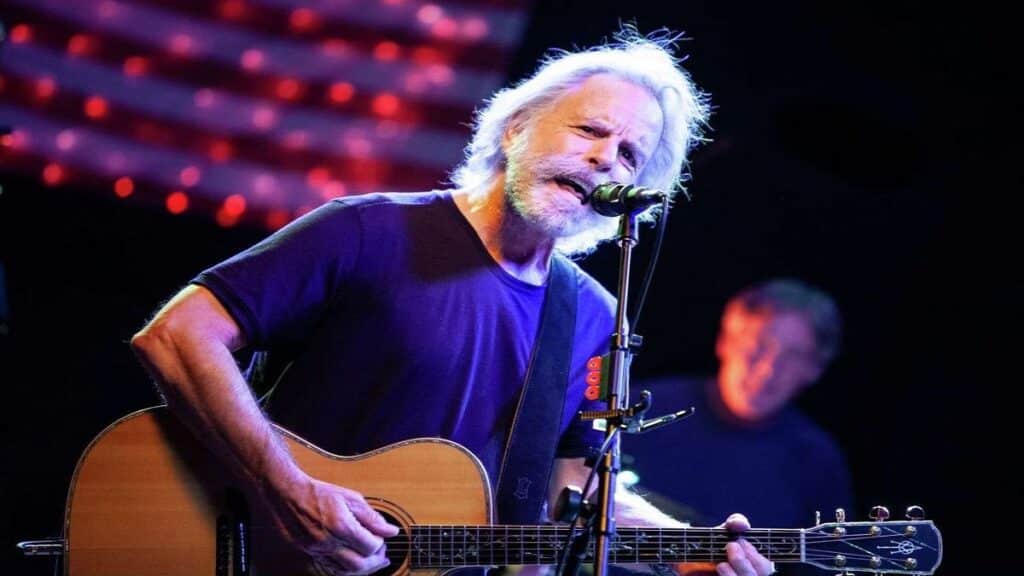

Bob Weir, The Heart Of The Grateful Dead : There are some names in the history of rock music that are timeless, inspiring generations. One such name is Robert Hall “Bob” Weir. As the guitarist and founding member of the Grateful Dead, Weir didn’t just create a band; They created a cultural earthquake, a “Deadhead” nation whose roots still run deep today. But the story of Bob Weir goes far beyond just one band. This is the story of a musician who took the art of rhythm guitar to new heights, who had a rawness and intelligence in his voice, and who even today, in his seventh decade, rules the stage with an indomitable passion for music.
The Beginning : A Journey That Started in San Francisco
Bob Weir was born in 1947 in California. In his teenage years, he got inclined towards folk and jazz music. It was the 60s, San Francisco was at its peak. It was during this time that a young Bob met Jerry Garcia. This meeting proved to be a turning point in music history. In 1965, Garcia, Weir, Ron “Pigpen” McKernan, Phil Lesh, and Bill Kreutzmann joined together to form “The Warlocks“, which would later become the Grateful Dead. Bob was the youngest member, but his musical understanding was extremely mature.
Bob Weir’s Unique Contribution to The Grateful Dead : Not Just A Rhythm, A Cornerstone
In most rock bands the lead guitarist gets all the credit. But the secret to the Grateful Dead’s magical sound lay in Bob Weir’s rhythm guitar. While Jerry Garcia played melodic, flowing lead lines, it was Bob Weir’s job to give the music structure and complexity. He wasn’t just playing charades; Like a tonal painter, he was adding layers to the guitar that gave the Dead’s jams a new dimension. He developed the rhythm guitar as a solo instrument, taking inspiration from jazz, bluegrass and avant-garde music.
His guitar style is often said to be a “conversation”. He would respond to Garcia’s lead, push him, and sometimes change direction altogether. This dynamic is what makes the Grateful Dead’s live shows unpredictable and exciting. Many of the Dead’s most famous songs, such as “Jack Straw,” “Sugar Magnolia,” and “Estimated Prophet,” were written by Bob Weir, demonstrating his literary depth and storytelling ability. You can experience this magic for yourself by visiting the official archives of the Grateful Dead.
Journey After The Dead : A Never Tired Traveler
The Grateful Dead ended with the death of Jerry Garcia in 1995, but Bob Weir’s musical journey did not stop. He never considered himself “retired”. He started projects like RatDog and collaborated with countless artists. In recent years, he has toured with Dead & Company, giving rise to a new generation of Deadheads.
But Bob Weir’s greatest legacy is perhaps his flexibility and curiosity. He is always ready for new experiments. In 2016, he released his solo album “Blue Mountain“, which reflects his deep interest in cowboys and American roots music. Even in his 70s, he is on stage with the same energy as he was when he was 25.
Bob Weir’s Influence : A Legacy Bigger Than Just A Band
The Grateful Dead weren’t just a band; That was an incident. And Bob Weir was at the center of it. The Dead’s influence extended to fashion, art, and technology (including the first online fan communities on the Internet). Bob Weir, along with his colleagues, redefined the “live music” experience. Every show was unique, every jam a new discovery.
Today’s youth bands, from jam bands like Fork to indie rock acts, all bear the influence of the rhythmic complexity of the Grateful Dead and Bob Weir. He proved that rock music isn’t just three chords and a hook; It is a collective journey, a conversation in which the listener is also an active participant.
Conclusion : An Immortal Beat
The story of Bob Weir is one of unfulfilled potential, an undying love for music, and constant growth. He was the heart of the Grateful Dead that gave life to the entire body. Today, when we see him on stage, we see not just a great musician, but a chapter in the living history of American music. He is like a bridge that connects the psychedelic dream of the 60s with the digital world of the 21st century.
Bob Weir’s message is clear: music never ends, it just changes form. And as long as that beat continues, a nation of Deadheads will live on, dancing and singing to the rhythm of Bob Weir’s guitar. His legacy lives on not just in recordings, but on every stage where musicians dare to play from the heart, without boundaries. And this is the true “Grateful Dead”.


